 22 Jul 2026
Recently, a research team led by Professor Haifeng Wang from the Research Institute of Industrial Catalysis and the Centre for Computational Chemistry, School of Chemistry and Molecular Engineering, ECUST, published a theoretical study titled “Disentangling the Activity-Charge Coupling in Cocatalyst-Semiconductor Heterojunctions for Optimized Oxygen Evolution” in Energy & Environmental Science, reporting the latest progress in the mechanistic understanding of cocatalyst-semiconductor heterojunction photocatalytic oxygen evolution reaction (OER).
Solar-driven water splitting for hydrogen production is a key pathway toward green energy conversion. The OER, however, involves multi-electron and multi-proton transfer processes with sluggish kinetics, making it a major bottleneck for improving overall photocatalytic efficiency.
Although loading cocatalysts onto semiconductor surfaces has long been considered an effective strategy to enhance OER activity by providing active sites to lower surface reaction barriers and regulating interfacial charge distribution to promote photogenerated hole accumulation, these two effects are often highly coupled in real cocatalyst-semiconductor heterojunction systems. This makes their individual contributions difficult to distinguish and results in a long-standing lack of a clear quantitative theoretical basis for rational cocatalyst design and performance optimization.
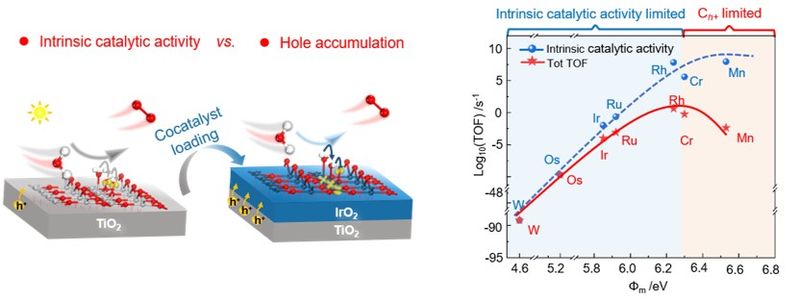
To address this challenge, the team used an IrO₂/TiO₂ cocatalyst-semiconductor heterojunction as a model system and combined ab initio molecular dynamics with first-principles microkinetic simulations to investigate the OER process at the solid-liquid interface. They developed a decoupling framework that separates intrinsic catalytic activity (ICA) from hole accumulation capacity (HAC), enabling quantitative evaluation of cocatalyst functions.
The results showed that in the IrO₂/TiO₂ system, the increase in the OER rate did not originate from the higher intrinsic catalytic activity of IrO₂ sites. Instead, excessively strong oxygen binding at Ir sites hindered O-O bond formation to a certain extent and was unfavorable for the intrinsic OER kinetics. The excellent OER performance exhibited by this system mainly arose from the increased surface hole concentration driven by the Schottky junction at the heterojunction interface and the strong hole accumulation capacity of IrO₂.
The research team further extended this analysis to a series of rutile-type metal oxide cocatalysts and revealed a seesaw-like competitive relationship between ICA and HAC: Cocatalysts with lower work functions were conducive to enhancing interfacial hole accumulation but simultaneously strengthened oxygen species adsorption, which suppressed crucial O-O bond formation. In contrast, higher work functions weakened charge accumulation capacity and limited the overall OER efficiency.
Therefore, optimal OER performance can only be achieved by striking an appropriate balance between intrinsic reaction activity and interfacial charge accumulation capacity. Based on this trade-off, the work function was proposed as a unified descriptor bridging hole accumulation capacity and intrinsic catalytic activity, and cocatalysts such as RhO₂ and CrO₂ with moderate work functions were predicted to show optimal performance in photocatalytic OER.
This study elucidated the microscopic mechanism of activity-charge coupling in cocatalyst-semiconductor heterojunctions regulating photocatalytic OER from a theoretical perspective, breaking through the conventional and generalized view that cocatalysts simply enhance intrinsic activity or increase hole concentration. The findings deepened the understanding of interfacial oxygen evolution processes in photocatalytic water oxidation and provided general design principles for efficient heterojunction catalytic materials for solar fuel production.
The paper is co-first authored by Postdoctoral Fellow Ying Liu and Research Associate Professor Min Zhou from the School of Chemistry and Molecular Engineering, ECUST, with Professor Haifeng Wang as the corresponding author. The work was supported by the State Key Laboratory of Green Chemical Engineering and Industrial Catalysis, the National Key Research and Development Program of China, and the National Science Fund for Distinguished Young Scholars of China.