
New Progress from ECUST in Thermal Failure Mechanism of Gas Foil Thrust Bearings
Recently, a research group at the School of Mechanical and Power Engineering published a paper in the International Journal of Mechanical Sciences (2026, 317: 111523). This study addressed the modeling challenges of gas foil thrust bearings in high-speed turbomachinery and proposed and developed an accurate computational method.
Yang Wu is the first author of the paper, and Professor Qi An is the corresponding author. Other collaborators include Shuangmin Li, Congpeng Shao, Lei Gao, and Changle Guo.
High-speed turbomachinery is evolving toward high power density and oil-free operation. As a core supporting component, the operation of gas foil thrust bearings involves complex interactions among gas film pressure, structural deformation, and temperature fields.
In previous studies, the bump foil structure was mostly simplified as a spring model, or the effects of temperature variation were neglected. This made it difficult to accurately predict the thermal deformation of foils and its influence on bearing load capacity at high rotational speeds, which limited the reliability of bearings in practical applications.
To solve this problem, the research team established a coupled thermo-elasto-hydrodynamic (TEHD) model. The model incorporates contact thermal resistance and a smooth-function-based stick and slip friction model, enabling the coupled analysis of mechanical deformation and heat conduction in the bump foil.
Computational efficiency is further enhanced through techniques such as the condensation of the degrees of freedom, while maintaining accuracy. This method overcomes the limitation of traditional models that ignore thermal deformation of bump foils, allowing more accurate prediction of the critical speed and load capacity of bearings at ultra-high rotational speeds.
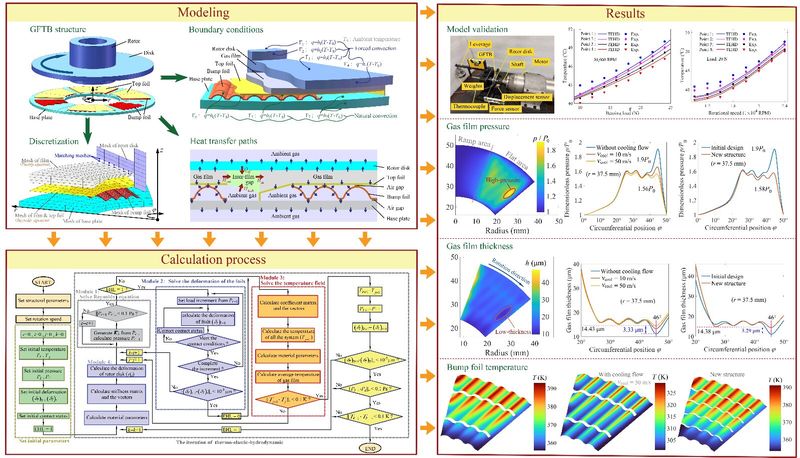
The results indicate that the bump arches near the fixed end experienced substantial thermal deformation and axial warping, leading to a sharp reduction in gas film thickness in this region and the formation of a local high-pressure zone. This phenomenon is a key factor contributing to the decrease in bearing critical speed and load capacity.
On this basis, the study proposed two measures to mitigate thermal deformation: introducing a cooling airflow between the top foil and base plate and reducing the radial dimensions of bump foil strips, and their effectiveness was experimentally validated.