
Two State Key Laboratories Signed a Strategic Cooperation Agreement to Build a Full-Chain Innovation Hub for Low-Carbon Biomanufacturing
Recently, the State Key Laboratory of Bioreactor Engineering and the State Key Laboratory of Low-Carbon Synthetic Engineering Biology officially signed a strategic cooperation framework agreement. Director Bangce Ye from the State Key Laboratory of Bioreactor Engineering and Director Yiheng Zhang from the State Key Laboratory of Low-Carbon Synthetic Engineering Biology signed the agreement on behalf of their laboratories respectively.
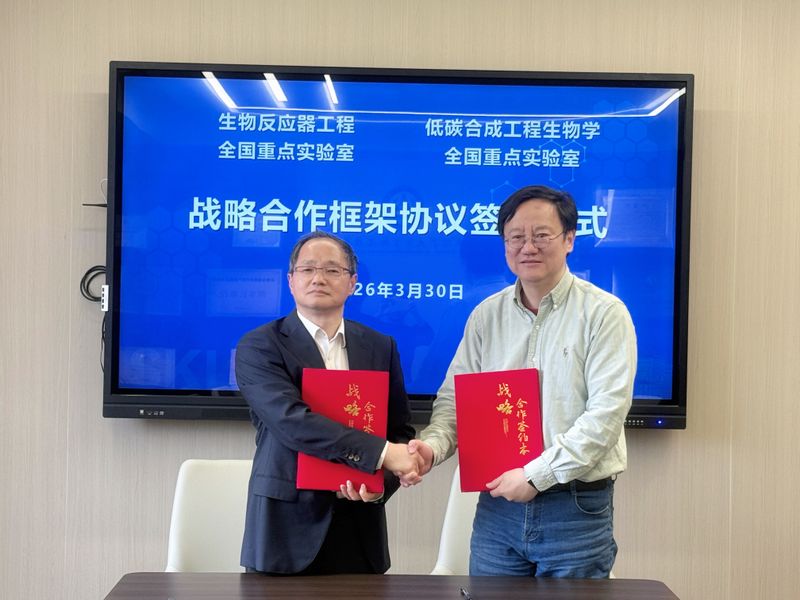
This event marked a new stage of deep collaboration and integrated development for the two national scientific and technological innovation platforms. The State Key Laboratory of Low-Carbon Synthetic Engineering Biology aligns with the national Carbon Peaking and Carbon Neutrality Goals. It focuses on the bio-industrial utilization of renewable carbon resources and dedicates its efforts to the engineering design of industrial organisms and the construction of low-carbon synthesis routes.
Meanwhile, the State Key Laboratory of Bioreactor Engineering specializes in high-efficiency mass production technologies for biomanufacturing. It builds a new integrated engineering paradigm of “germplasm-process-equipment” designed for large-scale production. The two laboratories complement each other, and their innovation chains are highly interconnected.
According to the agreement, the two parties will collaborate on strategic directions like the biological utilization of carbon resources and the high-efficiency mass production of biomanufacturing. They will jointly conduct basic research on adaptability from high-efficiency cell factories to intelligent biological processes, tackle key technologies, and carry out integrated and coordinated innovation. This partnership will accelerate the transition of low-carbon biomanufacturing technologies from the laboratory to large-scale mass production and industrial application.
This signing ceremony was an important practice for national key laboratories to collaboratively serve national strategies through the full chain of “design, synthesis, and mass production”. Both parties stated that they would work together to break through core technologies in biomanufacturing. They aim to boost the high-quality development of China’s bioeconomy, ensure the security and stability of the industrial chain, and provide solid scientific and technological support for the realization of the “Dual Carbon” strategic goals.